
Your Old Content Is Invisible to AI: The New Rules for What Gets Cited
AI systems have a documented recency bias, citing URLs that are 393-458 days newer than what ranks organically. This guide shows how leading brands like HubSpot and SEO Engico decide what to refresh, delete, or restructure for AI search visibility, with a repeatable framework you can apply quarterly.
AI systems have a recency bias that's killing your archive. According to Slate's 2026 research, AI systems cite URLs that are 393-458 days newer than what ranks organically on traditional Google search. That guide you wrote three years ago? AI systems won't touch it. Here's how leading brands are deciding what to refresh, what to delete, and what to restructure for the age of AI search.
The Invisible Content Problem
You have years of content sitting on your site. Blog posts, guides, resources: some of it still gets traffic. Most of it doesn't. And here's what nobody told you: AI systems are actively ignoring it.
Google's AI Overviews, ChatGPT, Perplexity, Claude, and Copilot don't treat all content equally. They have a documented recency bias. AI-cited URLs are nearly 400 days fresher than what ranks in traditional search.
The visibility shift is real:
- 13% of all US desktop searches now show AI Overviews
- ChatGPT-based queries for information are up 212% since 2024
- Being invisible to AI means being invisible to a growing chunk of your audience
Why Old Content Fails in AI Search
Traditional SEO advice said: if it ranks, leave it alone. That logic no longer holds. Here's why old content underperforms in the AI era.
1. Freshness Signals Matter More Than Ever
AI systems use publication and modification dates as ranking inputs. A page last updated in 2022 competes against pages updated last month. The older page loses, not because the information is wrong, but because the system assumes newer is better.
What this means for you:
- Pages without recent updates get deprioritized automatically
- "Last modified" dates are explicit ranking signals
- Stale content loses to fresher competitors, even lower-quality ones
2. Structure Beats Substance
Old content was written for humans who scroll. AI systems scan for extractable chunks: question-based headings, direct answer paragraphs, comparison tables. Content structured around "Introduction, Body, Conclusion" doesn't give AI systems what they need to cite you.
AI-friendly structure requires:
- Question-shaped H2 headings ("How does X work?" not "Overview")
- Direct answers in the first 1-2 sentences
- Short paragraphs (under 150 words)
- Comparison tables and bulleted lists
3. Outdated Data Is a Disqualifier
A single statistic from 2021 can tank an otherwise excellent page. AI systems increasingly verify claims against their training data. Outdated numbers don't just look bad: they signal that the entire page may be unreliable.
Red flags AI systems notice:
- Statistics older than 18 months
- Screenshots of outdated software interfaces
- References to discontinued products or features
- Broken external links
4. Dead Weight Drags Down Your Domain
Every low-value page on your site dilutes your overall quality signals. Google's helpful content system evaluates sites holistically. A library of decaying content tells the algorithm your site isn't well-maintained.
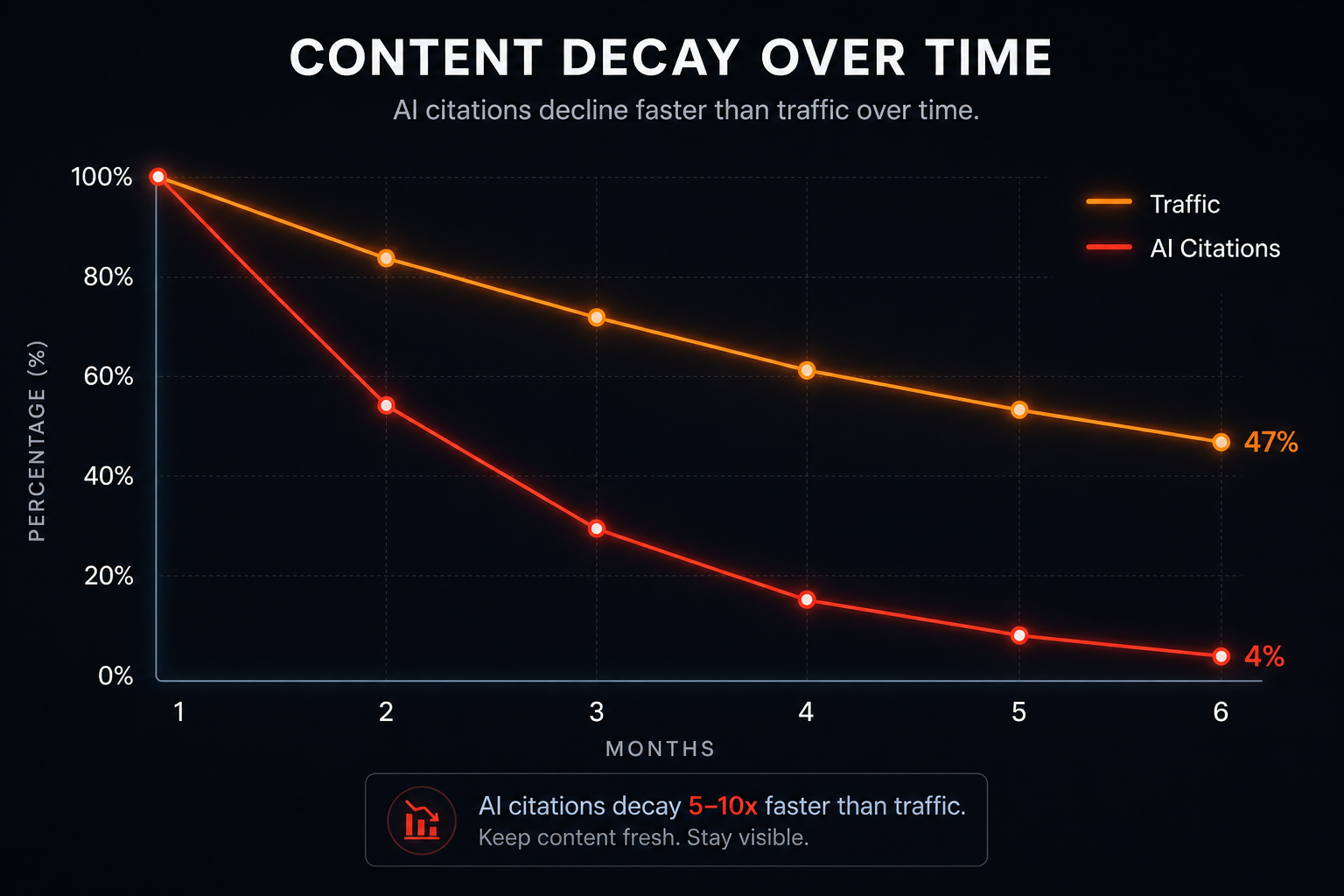
The Numbers Behind Content Decay
The data on content decay is sobering, and the implications for your content strategy are significant.
Content doesn't just gradually fade. It reaches a tipping point where recovery becomes exponentially harder. Ahrefs' 2025 analysis found that a sustained 20-30% drop in clicks over 4-8 weeks signals that decay has begun. At this point, the page is entering a downward spiral: fewer clicks lead to lower engagement signals, which lead to lower rankings, which lead to even fewer clicks.
The most striking finding comes from HubSpot's research on content refresh ROI. They found that updating an existing page takes roughly 20% of the effort required to write new content from scratch, but captures 60-80% of the ranking improvement you'd get from new content. This math is why smart content teams are shifting resources from pure content creation to strategic content maintenance.
| Metric | Finding | Source |
|---|---|---|
| Decay threshold | 20-30% drop in clicks over 4-8 weeks | Ahrefs, 2025 |
| Recovery timing | Waiting = 3-5x longer recovery | Industry data |
| Refresh ROI | 20% effort, 60-80% gains | HubSpot, 2025 |
| Citation location | 44.2% from first 30% of text | Slate, 2026 |
| Refresh frequency | Quarterly = 42% better results | Semrush, 2025 |
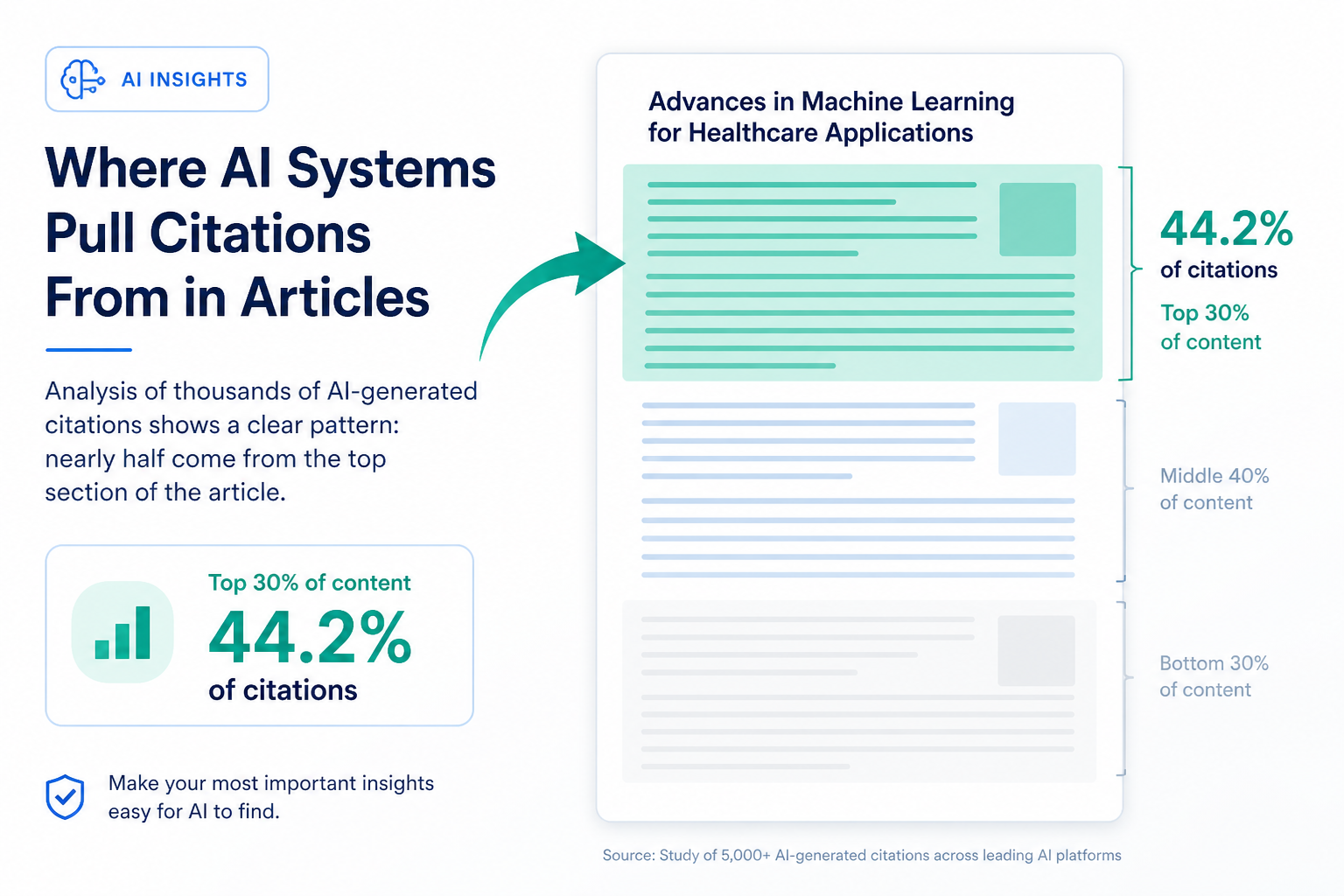
Perhaps the most important insight for AI visibility: Slate's 2026 research found that 44.2% of all LLM citations come from the first 30% of text. This means the structure of your content matters as much as its substance. If your key information is buried after a long introduction, AI systems will never find it, or worse, they'll cite your competitors who front-loaded their answers.
How Leading Brands Handle Old Content
The theory is one thing. But how are actual companies handling their content archives? These four case studies show different approaches, from mass deletion to surgical restructuring, and the results they achieved.
Case Study 1: HubSpot's Mass Deletion
HubSpot, one of the most prolific content publishers in the B2B space, faced a problem familiar to any company with years of content: their blog had become bloated with thousands of posts that weren't performing. Their solution was aggressive: they removed approximately 3,000 outdated blog posts in a single content audit.
The decision wasn't taken lightly. HubSpot's content team understood that 76% of their monthly blog views came from older posts, not recent ones. This is a pattern common across most established blogs: your archive often drives more traffic than your newest content. But that statistic also masks a critical truth: a small percentage of old posts drive the vast majority of that traffic, while the rest contribute nothing but dead weight.
Results:
- 20% decrease in crawl requests
- New content indexed "in minutes rather than hours or days"
- Ahrefs domain rating climbed steadily post-cleanup
The improvement in indexing speed was particularly notable. Before the cleanup, HubSpot's new content took hours or even days to appear in search results. After removing the dead weight, new posts were being indexed in minutes.
Case Study 2: The 4-Bucket System (SEO Engico)
SEO Engico faced a client with severe content bloat: thousands of pages accumulated over years, many of which were thin, outdated, or redundant. Rather than approaching this as a simple "keep or delete" decision, they developed a systematic four-bucket framework that gave every URL a clear path forward.
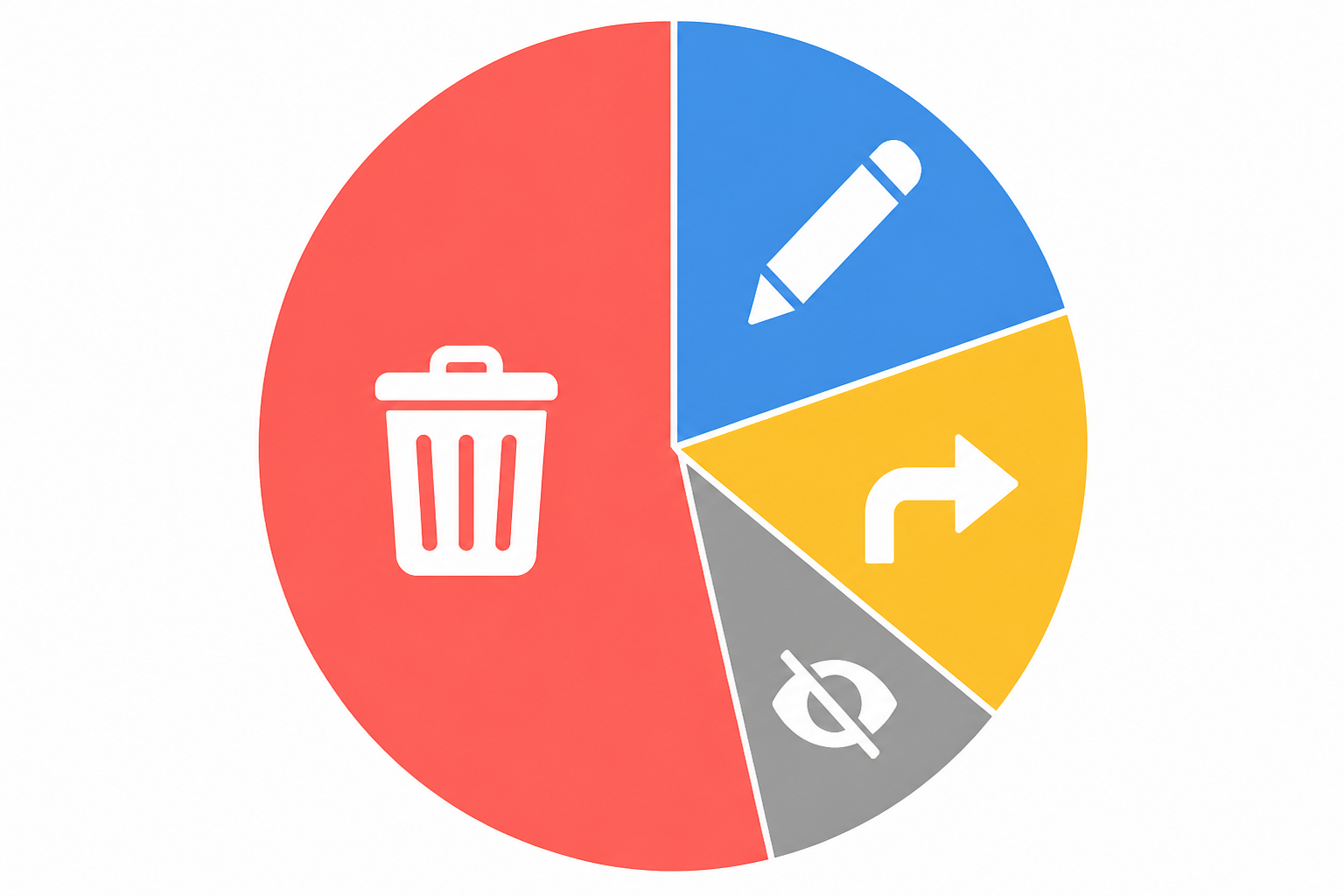
The framework forced a decision on every piece of content. No page was left in limbo, and no page was deleted without first considering whether it could be salvaged through other means.
| Bucket | % of Content | Action |
|---|---|---|
| Delete | 59% | 410 status code, permanent removal |
| Rewrite | 17% | Full content refresh with AI optimization |
| Redirect | 14% | 301 to topically similar stronger page |
| Noindex | 9% | Keep for users, remove from search index |
The most striking finding: 59% of the content needed to be deleted outright. This aligns with what other audits have found: the majority of accumulated content on most sites is simply not worth keeping.
Results:
- Organic clicks: 14,000/month to 19,200/month (+37%)
- Conversions: +31%
- New content indexing: dramatically faster
The 37% increase in organic clicks is notable, but the conversion improvement tells the real story. When you remove low-quality content, you're not just improving rankings: you're improving the overall user experience.
Case Study 3: Ecommerce Blog Pruning (Inflow + HomeScienceTools)
HomeScienceTools, an ecommerce company selling science education supplies, had accumulated years of blog content on a subdomain. They pruned roughly 200 pages, about 10% of the total blog.
Selection criteria for deletion:
- Little or no organic traffic
- Zero or minimal pageviews
- No conversions
- No backlinks
Notice what's NOT on this list: "outdated information." They didn't delete content just because it was old. They deleted content that wasn't performing by any metric. Old content that still drives traffic, generates backlinks, or converts visitors is worth keeping.
Outcome: Site-wide performance improved within weeks. The remaining content performed better because it wasn't competing with dead weight for crawl budget and internal link equity.
Case Study 4: Intent Shift Detection (Grow and Convert)
Sometimes old content fails not because it's bad, but because the world changed around it. Grow and Convert documented a case where content targeting "time clock software" stopped performing, not because it was bad, but because search intent shifted.
The keyword hadn't changed, but who was searching for it had. The rise of remote work meant that individuals, not just HR departments, were now searching for time tracking solutions. Google's algorithm detected this shift and started favoring content that addressed the new intent.
Their fix:
- Analyzed SERP changes to identify the intent shift
- Expanded content to address both audiences
- Updated all screenshots and tool examples
- Added comparison tables for AI extraction
Result: Rankings recovered and expanded to capture the new audience segment.
The AI-Era Content Refresh Framework
Now that we've seen what's possible, let's build a systematic approach you can apply to your own content library. This framework is designed to be repeatable: something you can run quarterly without reinventing the process each time.
Step 1: Identify What Needs Attention
Pull data from Google Search Console for the last 12-16 months. You want a long enough window to see trends, but not so long that you're comparing against a fundamentally different competitive landscape.
Flag any page that:
- Has declined 20%+ in clicks over 6 months
- Ranks positions 11-30 (striking distance, worth saving)
- Contains statistics older than 18 months
- Shows screenshots of outdated software/interfaces
- Has high impressions but low CTR (title/description problem)
The "striking distance" category (positions 11-30) is particularly important. These are pages that Google has already deemed relevant enough to rank on page two or the top of page three. They're not far from page one, and a focused refresh might be all they need to break through.
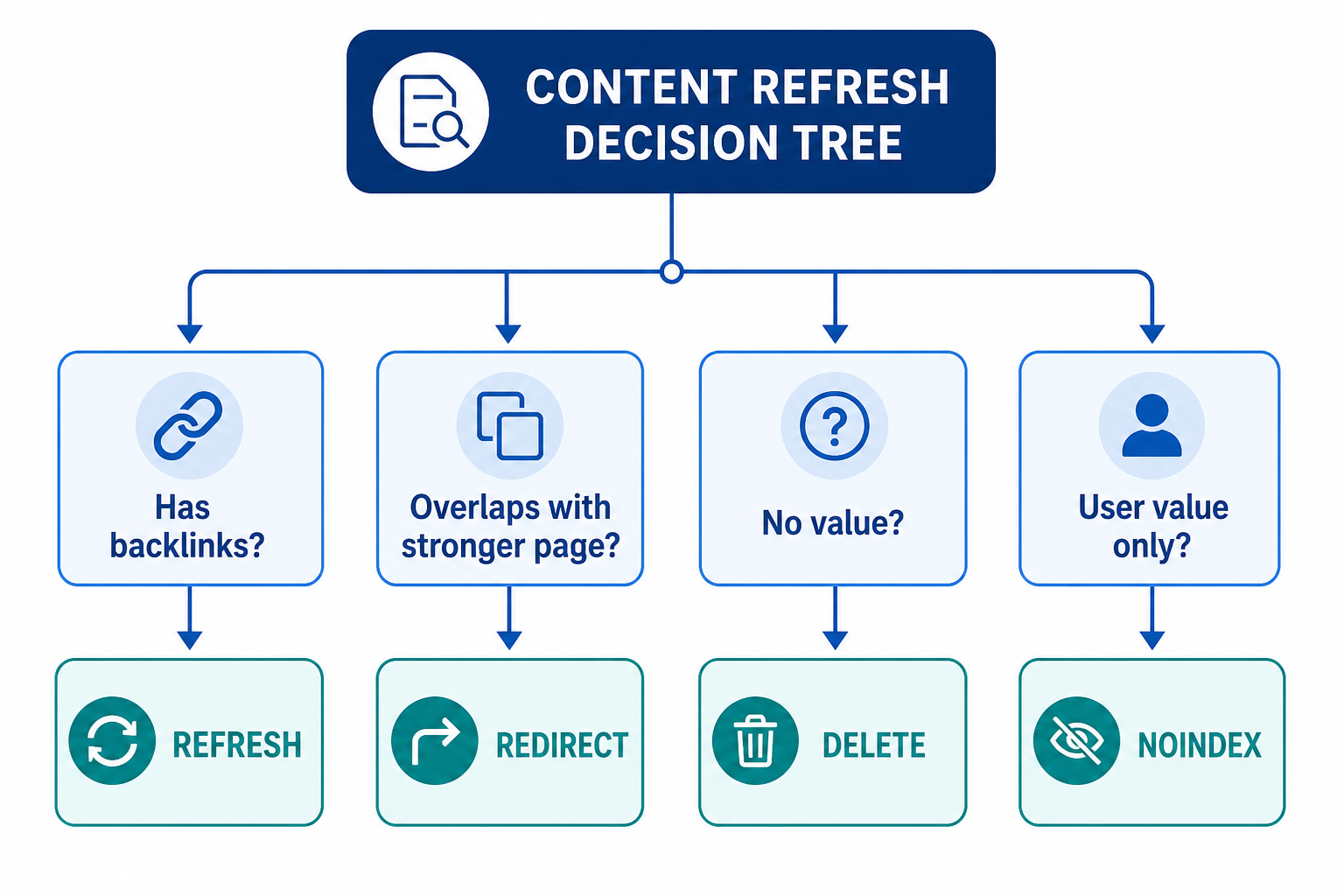
Step 2: Apply the Decision Framework
For each flagged page, use this decision matrix:
| If the page has... | Action | Priority |
|---|---|---|
| Backlinks + recoverable topic | Refresh: full rewrite for AI | High |
| Overlap with a stronger page | Consolidate: 301 redirect | Medium |
| No traffic, no links, no value | Delete: 410 status | High |
| User value but no search value | Noindex: keep page, remove from Google | Low |
Golden Rule: Never delete a page with backlinks without redirecting to a relevant alternative first.
Step 3: Refresh for AI Extraction
For pages worth keeping, restructure for how AI systems read. Use question-shaped H2 headings like "How does X work?" instead of "Overview of X". Place direct answers in the first 40-60 words under each heading. Keep paragraphs under 150 words to match RAG system chunking. Use comparison tables for data presentation.
| Element | Traditional | AI-Optimized |
|---|---|---|
| H2 headings | "Overview of X" | "How does X work?" |
| Answer location | After long intro | First 1-2 sentences |
| Paragraph length | 200+ words | Under 150 words |
| Data presentation | Inline text | Comparison tables |
| Freshness signal | None | "Last updated: Month Year" |
| Schema | Basic | Article + dateModified |
Step 4: Delete Safely
Deletion is the most nerve-wracking part of content maintenance. There's always a fear that you'll remove something important and tank your traffic. But with the right process, you can delete confidently and recover quickly if anything goes wrong.
For pages being removed:
- Export backlinks first: Any page with external links needs a 301 redirect to a relevant alternative. Losing backlinks means losing authority.
- Use 410, not 404: The 410 status code (Gone) tells Google to stop crawling immediately. A 404 suggests the page might return.
- Remove from sitemap before setting the status code.
- Batch your deletions: Never remove more than 15-20% of your total content at once.
- Wait 48 hours between batches: This gives you time to monitor Search Console for unexpected drops.
- Document everything: Keep a spreadsheet of every URL you delete, when you deleted it, and where you redirected it.
The Maintenance Calendar
One-time audits aren't enough. Build content maintenance into your operations:
Weekly: Monitor Search Console for unexpected traffic declines on key pages. Flag any page that drops 30%+ for immediate review.
Monthly: Mini-updates on your top 10 traffic pages. Refresh statistics, add recent examples and case studies, update any screenshots showing changed interfaces.
Quarterly: Full audit of declining content. Pull 6-month comparison data from Search Console. Flag all pages with 20%+ click decline. Apply the 4-bucket decision framework.
Annually: Complete content inventory review. Full site crawl and content categorization. Strategic pruning of dead weight. Consolidation of overlapping content.
Threshold Rules:
- Statistics older than 18 months: Replace or remove
- Screenshots older than 12 months: Verify or update
- External links: Check annually for 404s
What About Content That's Still Performing?
Not all old content needs intervention. In fact, one of the biggest mistakes you can make is "optimizing" content that's already working well. If a page is ranking positions 1-5, maintaining or growing traffic, generating conversions, and being cited in AI Overviews: leave it alone.
There's real risk in touching high-performing content. Google has already decided that your page is the best answer for certain queries. Making changes, even well-intentioned ones, can disrupt that assessment.
However, even performing content benefits from light maintenance:
- Updated publication dates when you make substantive changes (not cosmetic edits)
- Periodic screenshot/example refreshes to keep the page looking current
- New internal links from your recent content pointing to these high performers
- Schema markup additions if they're missing
The key is proportionality. Your top performers get light maintenance. Your declining content gets full refreshes or deletion. Allocate your effort where it will have the most impact.
The Bottom Line
The AI era has changed the economics of content. Old content isn't just stale: it's actively invisible to a growing portion of how people find information.
| Action | % of Old Content |
|---|---|
| Delete outright | 40-60% |
| Complete AI restructuring | 15-20% |
| Traditional refresh | 20-30% |
| Leave alone (performing fine) | 10-15% |
HubSpot, Inflow, SEO Engico, and dozens of documented cases show the same pattern: aggressive content pruning improves performance for everything that survives, refreshing existing content delivers higher ROI than creating new content, AI-optimized structure matters as much as the information itself, and regular maintenance prevents catastrophic decay.
The question isn't whether your old content needs attention. It's whether you act now, while recovery is still straightforward, or wait until AI systems have deprioritized your entire domain. Every month you delay, the gap between your content and AI-cited competitors widens.
Start Your Content Audit Today
Ready to improve your AI visibility? LLM Scout tracks how your brand appears across ChatGPT, Perplexity, Claude, and Google AI Overviews. See which of your pages are being cited, which competitors are winning citations you should have, and where to focus your content refresh efforts. Try LLM Scout free and start measuring your AI visibility today.