
Profound vs Peec AI: Which AI Visibility Tool Is Better?
Both tools track whether your brand gets named in ChatGPT, Gemini or Perplexity. Profound is built for enterprise budgets and deep workflows. Peec AI fits marketing teams and agencies at a mid-market price. Here is how they compare, and where a lighter option fits.
TL;DR: Both tools answer the same question: when a buyer asks ChatGPT, Gemini or Perplexity for a recommendation, does your brand get named? They answer it for very different buyers. Profound is built for enterprise teams with enterprise budgets. Peec AI is built for marketing teams and agencies who want the same signal without the enterprise price. Here is how they compare, and where a lighter option fits.
The short version. Choose Profound if you are an enterprise or agency that needs deep answer-engine analytics, real-time topic data and built-in content workflows, and a four-figure monthly budget is not the blocker. Choose Peec AI if you are a marketing team or smaller agency that wants clean prompt tracking, share of voice and competitor gaps at a mid-market price. If both feel heavier or pricier than the job needs, the alternative at the end covers the same core signal from about $100 a month.
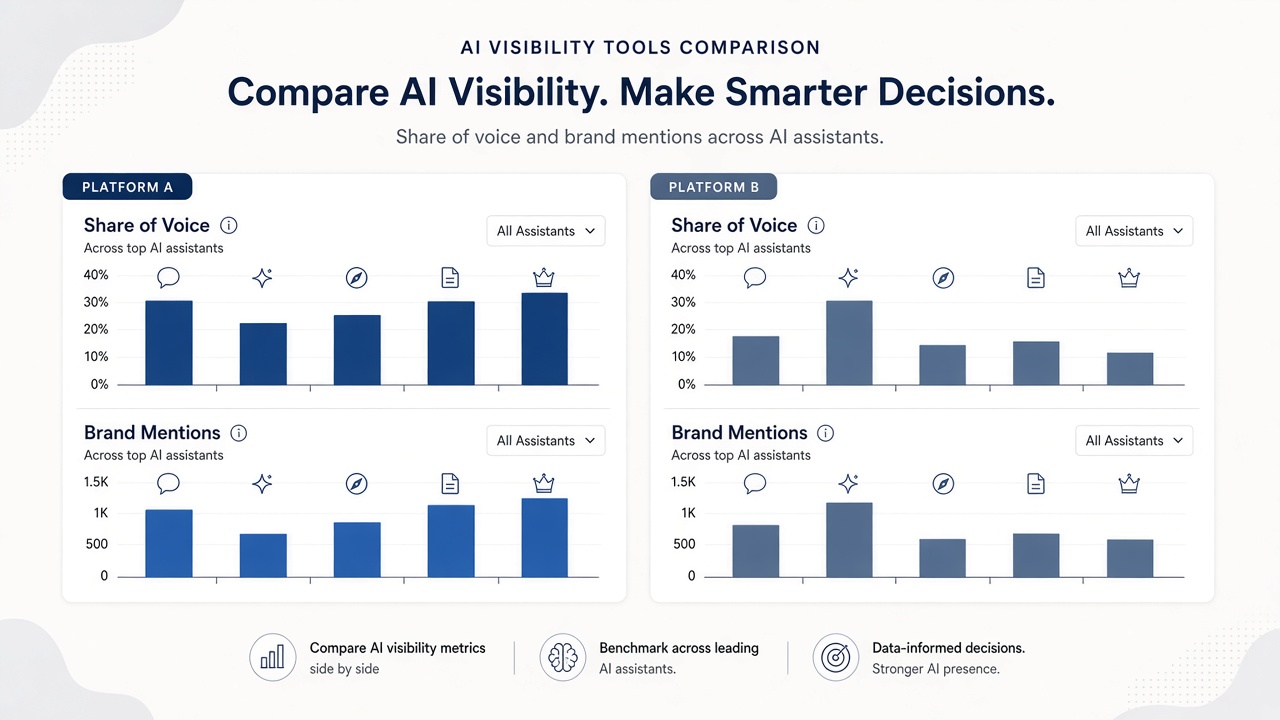
Side by side
| Profound | Peec AI | |
|---|---|---|
| Built for | Enterprise and Fortune 500 marketing teams, and agencies serving them | In-house marketing teams and SEO agencies, mid-market and up |
| AI engines tracked | ChatGPT, Perplexity, Google AI Overviews, Google AI Mode, Gemini, Copilot and Claude, with Amazon Rufus flagged as coming | ChatGPT, Perplexity, Gemini, Copilot, Google AI Mode and AI Overviews on self-serve, with more models including Claude on Enterprise |
| Entry price | Starter around $99/mo, but that tier covers ChatGPT only. Three engines start on Growth at around $399/mo | Starter from about $80/mo billed annually, covering three models of your choice |
| Top tier | Enterprise is custom, with third-party reports putting it in the $2,000 to $5,000+ a month range | Advanced is around $420/mo billed annually. Enterprise is custom with unlimited prompts and full model access |
| Core tracking | Mentions, citations, share of voice, sentiment and position across answer engines | Prompts grouped by topic, share of voice, sentiment, position, and mentions split from explicit citations |
| Standout feature | Conversation Explorer, which surfaces real-time AI search volume and trending prompts that were previously invisible | Gap analysis and perception mapping, showing sources that cite rivals but not you and how the models frame your brand |
| Content optimisation | Built in. Workflows generate and optimise content aimed at getting picked up by answer engines | Not built in. Peec measures and diagnoses, you act on it in your own stack |
| Crawler and agent data | Agent Analytics tracks how AI bots crawl and act on your site | Crawlability auditing checks robots.txt compliance across AI crawlers |
| Integrations | API and SSO on Enterprise, exports on Growth and up | Looker Studio and MCP export to Claude, Cursor and n8n. API and SSO are Enterprise only |
| Learning curve | Steep. It is a lot of tool, and it rewards a team that will use all of it | Light. Most teams are reading useful data on day one |
Prices and model coverage on both tools have moved more than once over the past year, so treat the figures above as a guide and confirm the current numbers on each vendor's pricing page before you commit.
What each tool is built for
Profound
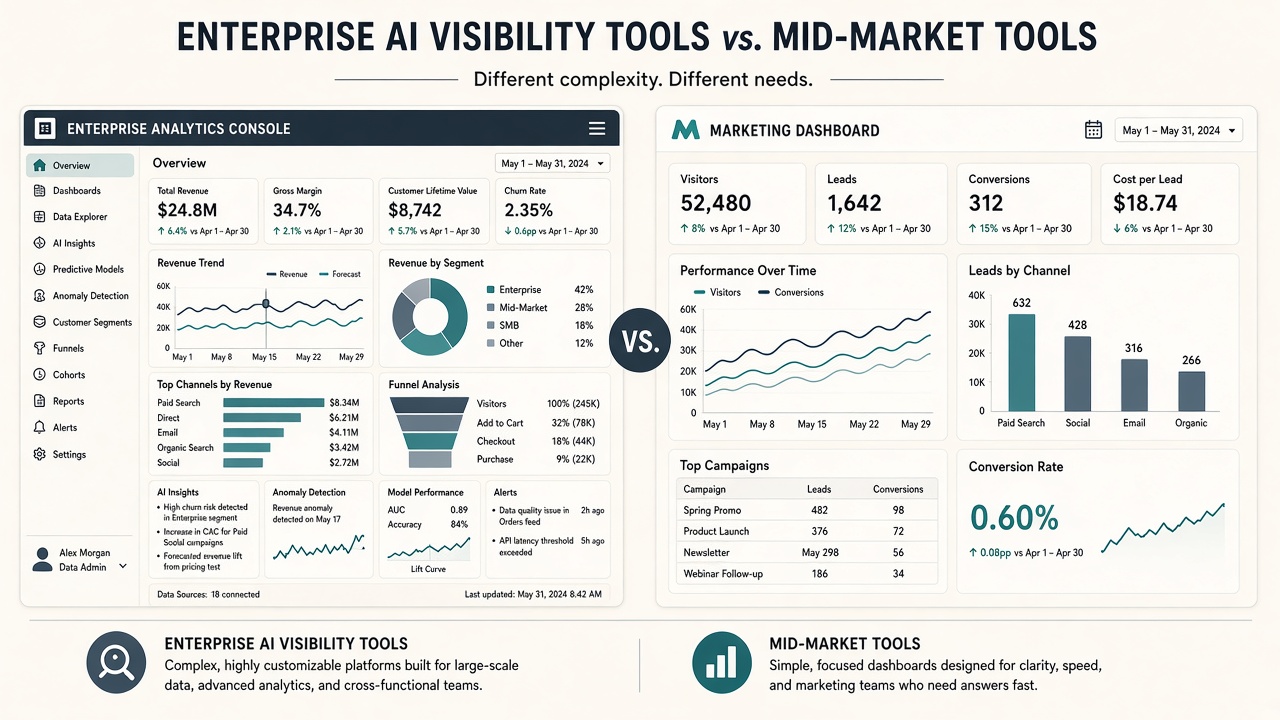
Profound is the heavyweight. It is used by thousands of marketers at large companies, and it is priced for them. Beyond mention and citation tracking, it adds Conversation Explorer for real-time prompt volume, Agent Analytics for how AI bots interact with your site, and Workflows that write and optimise content for answer engines inside the platform. That breadth is the point, and it is also the catch: the entry tier only watches ChatGPT, and the real coverage lives on Growth and Enterprise. If you have the budget and a team that will work the data, little else goes as deep.
Peec AI
Peec AI does the core job well and stays out of your way. Prompts are grouped by topic, so you see share of voice and sentiment by theme rather than as one flat number. Competitor benchmarking, citation versus mention splits, gap analysis and perception mapping are all there, and the interface is quick to read. It is the natural pick for a marketing team or agency that wants a reliable AI-visibility signal without a heavy rollout. The trade-offs are real too: three models by default, more cost more, and API and SSO sit behind Enterprise.
Which is better for your use case
Most people searching this comparison are really asking about one specific job. Here is the honest read on the common ones.
| Your use case | Better pick | Why |
|---|---|---|
| Enterprise-scale coverage | Profound | More engines, deeper analytics, API and SSO, built for large teams |
| Small or mid-sized business | Peec AI | Lower entry price and a shorter learning curve for a lean team |
| Non-technical marketers | Peec AI | Clean interface that reads clearly without a specialist to run it |
| Automated content workflows | Profound | Workflows generate and optimise answer-engine content inside the tool |
| Finding high-impact topics and prompts | Profound | Conversation Explorer surfaces real-time and fast-rising prompts |
| Brand visibility and share of voice | Either | Both do it well. Peec groups by topic, Profound goes deeper across more engines |
| Competitor and citation gaps | Peec AI | Gap analysis names the sources citing rivals but not you |
| Product or SKU-level visibility | Profound | Shopping and Amazon Rufus coverage lean toward product queries |
| How AI bots crawl your site | Profound | Agent Analytics is built for crawler and agent behaviour |
| Country and language tracking | Peec AI | Multi-country tracking from the Advanced tier |
Ranking higher in ChatGPT, Gemini, Perplexity or Claude
Neither tool ranks you. Both measure whether you appear, on which prompts, and who appears instead. That measurement is the actual work: you cannot fix a gap in Gemini or Perplexity that you cannot see. Profound covers the widest set of engines out of the box and adds content workflows to act on what it finds. Peec covers the main engines on self-serve and puts Claude and the rest on Enterprise. For Claude specifically, check the current plan coverage before you buy, since it has moved between tiers.
Sentiment, accuracy and misinformation
Both tools score sentiment on the answers models give about you, and both let you read the raw responses. That is how you catch a model stating something wrong about your brand. Neither is a dedicated misinformation or fact-checking system, so treat the sentiment and response logs as your early-warning signal rather than a compliance tool.
Referral traffic from LLMs
This is where every tool in the category hits the same wall. ChatGPT, Claude, the Gemini app and Perplexity send publishers almost nothing in the way of first-party traffic data. Profound and Peec both work by asking the assistants your buyer questions and recording the answers, not by reading a traffic feed the assistants do not provide. If measuring referral clicks is the whole goal, pair either tool with your analytics and Search Console rather than expecting the visibility tool to close that gap alone.
How they compare to other AI visibility tools
Profound and Peec are not the only two names in the shortlist. The others worth knowing, briefly and fairly:
- Otterly.AI is a lighter, lower-cost monitor aimed at smaller teams that want the basic mention and citation signal without the depth of the two above.
- Semrush folds AI visibility into its wider SEO suite, which suits teams that already live in Semrush and want one login for search and AI.
- Writesonic leans toward content generation with AI-visibility tracking attached, so the pitch is measure and produce in one place.
- Evertune focuses on how models represent a brand across prompts and personas, more brand-perception than day-to-day tracking.
- SimilarWeb, seoClarity and BrightEdge are enterprise platforms adding AI-visibility modules onto large existing analytics or SEO products.
The pattern across all of them is the same trade-off you see between Profound and Peec: more depth and more engines cost more, and simpler tools cost less but see less. The right pick is the one whose coverage and price match the job you actually have.
A lighter alternative worth a look
If you have read this far and neither the enterprise price of Profound nor the per-model add-ons of Peec fit the job, that is exactly the middle LLM Scout is built for. It tracks buyer prompts across the AI assistants, including the ones that report nothing back to publishers, and shows mention rate, citations, share of voice and the competitor gaps where AI names someone else instead of you. It is built to be readable without a specialist and to cover the core signal at a single, flat price rather than a tier ladder.
It is not trying to be Profound. There is no built-in content generation engine and no Fortune 500 feature list. If you need those, Profound earns its price. If you mainly need to know where you stand across the assistants and where the gaps are, without a four-figure invoice or a rollout, LLM Scout is the cheaper way to get that answer.
See where AI names you, and where it names your competitor
LLM Scout tracks buyer prompts across ChatGPT, Claude, Gemini and Perplexity, and shows your mention rate, citations, share of voice and competitor gaps, including the platforms that report nothing back to publishers.
Advanced plan, $99.99/mo after the trial.
Further reading
- Traditional SEO vs AIO What AI optimisation actually measures, what Google officially says, and what you can now track first-party.
- AI cites lists, not homepages Ranked listicles win most citations. Comparison pages like this one are where the mentions live.
- Why AI referral traffic is falling Fewer links per answer means clicks drop even when prompt volume is up. Measure mentions, not only sessions.
Last reviewed September 2026. Pricing and model coverage for both tools change often, so check each vendor's current pricing page before you decide.